
Custom transducers
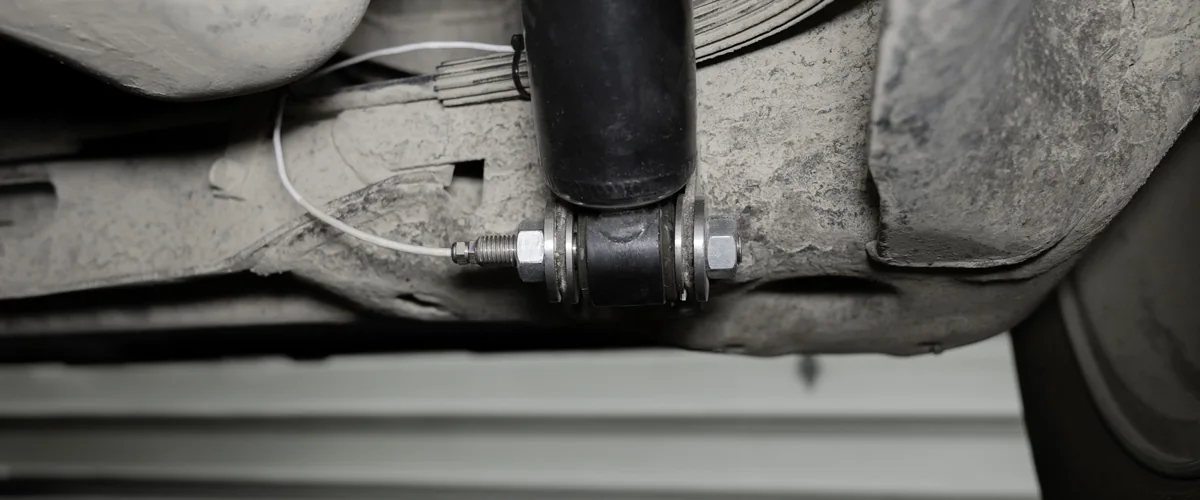
A production part strain gaged and calibrated as a force or torque transducer, mounted in place of the original part.
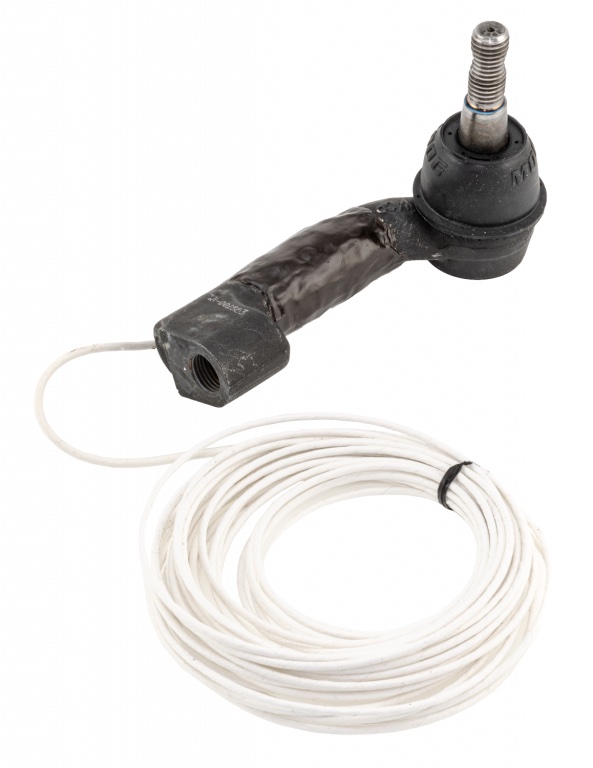
Michigan Scientific gages tie rod ends, half shafts, propshafts and shear pins. A tie rod end transducer replaces the production tie rod end with no vehicle modification and takes no additional space under the vehicle.
- 4 steps
- Load case, design, strain gaging, calibration
- ISO/IEC 17025
- Accredited calibration of the finished transducer
- Temperature compensated
- With a weatherproof coating, like all Michigan Scientific transducers
- No modification
- To the vehicle, for a tie rod end transducer
What we build
- Tie rod end transducers Made from nearly any tie rod, including the customer's production tie rod. Replaces the inner or outer tie rod end and measures the axial force, in tension and compression, during steering.
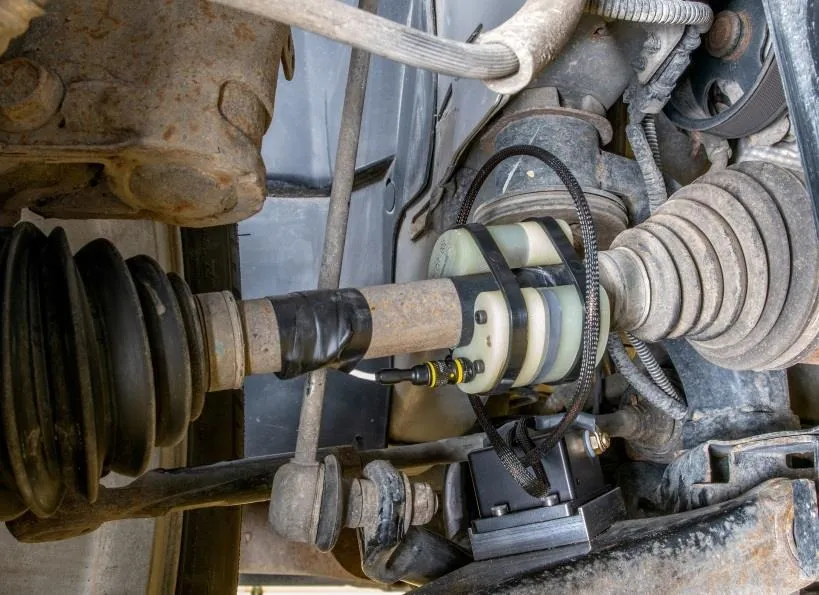
- Strain gaged half shafts and propshafts The customer's shaft, strain gaged and calibrated for torque. The signal leaves the shaft through a tubular slip ring or a clamp-on telemetry transmitter.
- Wheel instrumentation Strain gage, thermocouple, speed and acceleration signals from the wheel, brake, tire, hub or axle, through a waterproof package bolted to the series wheel. From forklift trucks to class 8 tractors.
- Shear pins Shear pins on suspension links, gaged and calibrated to measure the force through the pin.
- Custom slip rings Slip ring assemblies designed to the signals, speed and space of the application: up to 60 circuits and 20 000 rpm.
Two examples
From published Michigan Scientific application notes.
- Steering
Tie rod end transducer
Need. Measure the tie rod forces during steering, to build and verify a vehicle simulation model.
Answer. A tie rod end transducer made from the production tie rod. It replaces the tie rod end with no vehicle modification other than a routing path for the lead wires.
Result. axial force, tension and compression · no additional space under the vehicle
- Powertrain
Torque through a half shaft
Need. Measure half shaft torque on the vehicle.
Answer. The production half shaft strain gaged and calibrated. The signal leaves through a tubular slip ring or a CIT clamp-on telemetry transmitter.
Result. torque on the production shaft · tubular slip ring or 2.4 GHz CIT telemetry
From the drawing to a calibrated part
- 01
Load case
You send the part or its drawing, the loads and the environment. We assess whether the part can be gaged as a transducer, and at what accuracy.
- 02
Design
Gage locations from finite element analysis, wire routing, sealing, and the signal path off the part.
- 03
Strain gaging
Gages bonded, wired and protected in the Michigan Scientific workshop, on your part or on parts we supply.
- 04
Calibration
The finished transducer is calibrated in the accredited laboratory and delivered with its certificate and sensitivity.
What we need to quote: the part or its drawing, the expected loads and their directions, the environment, the number of units, and how the signal leaves the part.
A part to instrument?
Send the drawing and the load case. An application engineer replies with a feasibility assessment and a first price.
More details to give? Use the full contact form.